Everyone photographs the Sedona red rocks. Almost nobody knows what they’re looking at.
The short version: Sedona’s rocks are red because they’re rusty. The long version involves an ancient sea, a desert the size of a continent, a couple hundred million years of patient burial, and a comparatively recent bout of erosion that carved the whole thing into the shapes you drove here to see.
It’s worth knowing. It changes how the landscape looks.
The color is rust. Literally.
The red comes from iron oxide, the same chemical process that turns a left-out bike orange, running at geological scale.
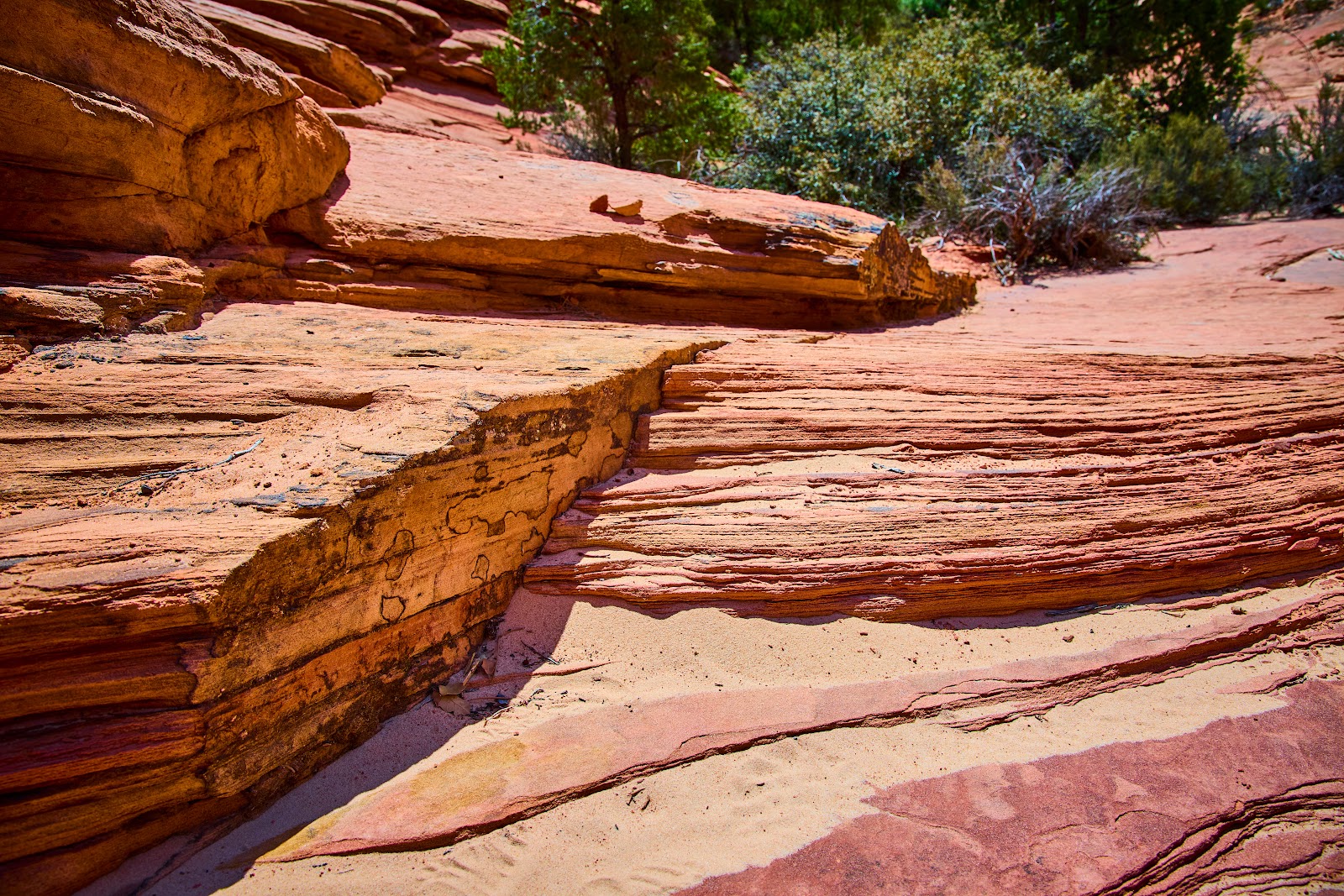
Sedona’s most visually dominant rock layers are sandstone, formed from ancient sand. Those sand grains carry trace amounts of iron. When iron is exposed to oxygen and water over long enough spans, it oxidizes, and the resulting iron oxide coats each individual grain in a thin red-brown film.
Multiply that by an unfathomable number of grains, stack it into cliffs hundreds of feet high, and light it with Arizona sun, and you get Sedona.
The intensity varies layer by layer depending on how much iron is present and how thoroughly it oxidized, which is why the formations aren’t uniformly red but banded, shifting between deep rust, orange, buff, and near-white as your eye moves up a cliff face.
The layer doing most of the work
The formation most responsible for Sedona’s signature look is the Schnebly Hill Formation, named, as it happens, for the same family the town is named after.
It dates to the Permian period, roughly 280 million years ago, and it formed in an environment that would be unrecognizable today. Arizona at that point sat near the equator. The region cycled between shallow coastal sea and enormous inland dune fields, a desert on a scale closer to the modern Sahara than anything in the current Southwest.
Look closely at certain cliff faces around Sedona and you can actually see it: sweeping diagonal lines running through the rock at angles that don’t match the horizontal bedding around them. Those are cross-beds, the preserved faces of ancient sand dunes, frozen mid-migration and turned to stone. (The most dramatic large-scale cross-bedding visitors notice is more classically associated with the Coconino Sandstone layer above, see below, though Schnebly Hill has its own cross-bedded coastal-dune sections too.)
You are, quite literally, looking at the shape of wind from 280 million years ago.
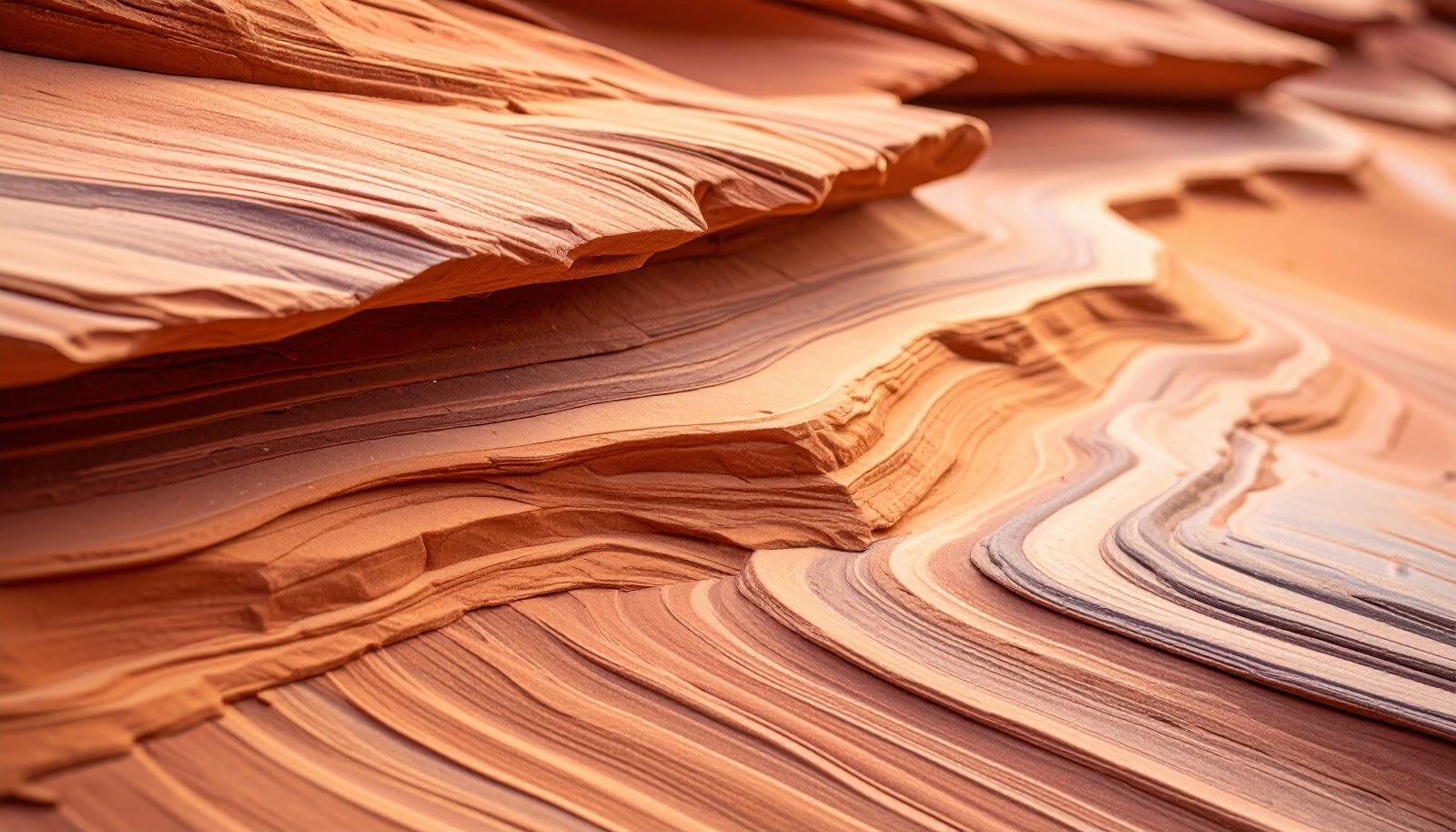
The white caps on top
Many of Sedona’s most famous formations wear a pale cap, a lighter layer sitting above all that red.
That’s typically the Coconino Sandstone, another ancient dune deposit, but one with far less iron staining, nearly pure quartz sand. It’s also harder and more resistant to erosion than the softer layers beneath it, which is why it survives as caps and rims while the material below wears away faster.
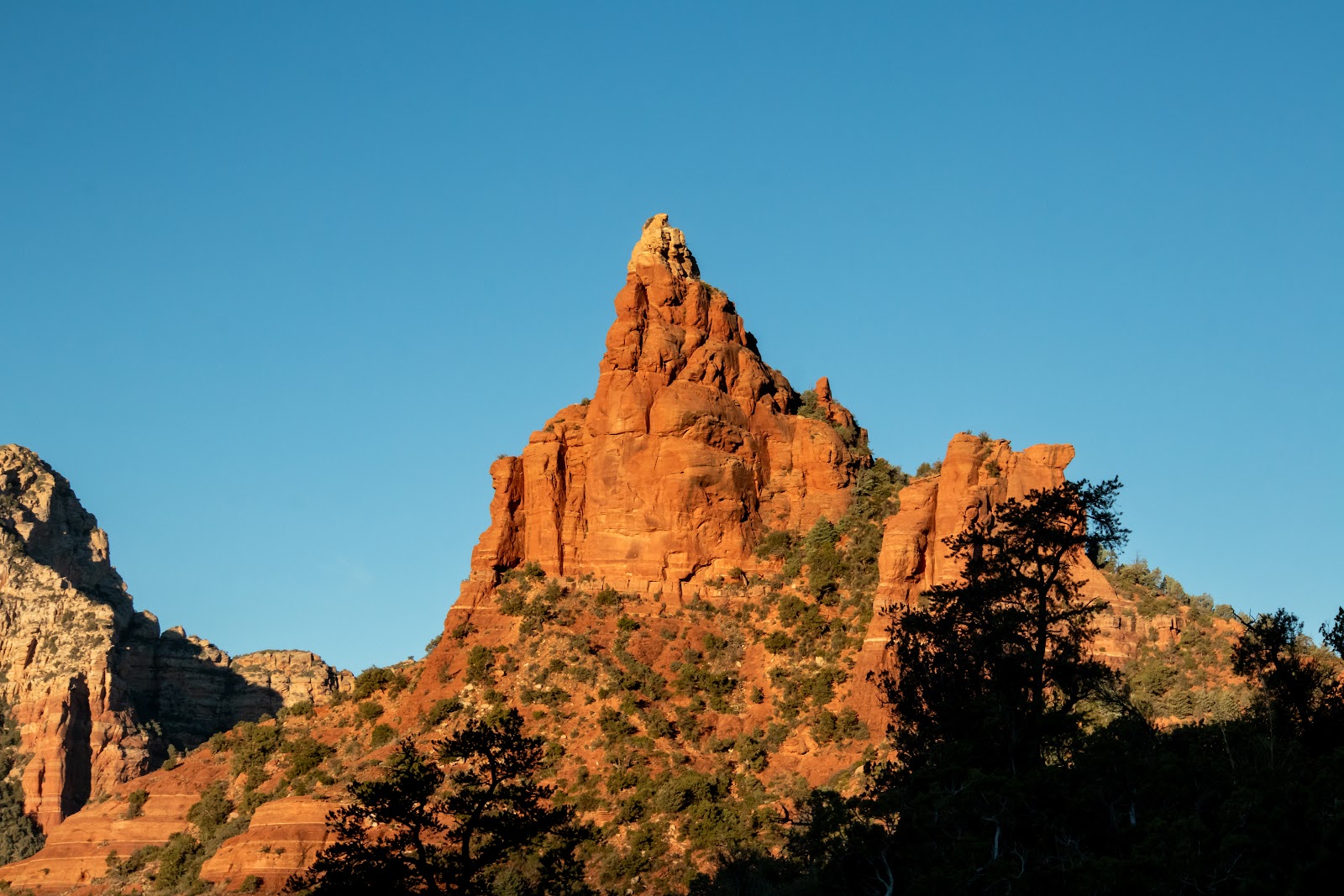
That hardness difference is the reason Sedona’s formations have their distinctive silhouettes, a resistant layer on top protecting softer rock underneath produces exactly the buttes, spires, and mesas the town is famous for.
Then everything got carved
For a very long time, all of this sat buried. What made Sedona Sedona is a much more recent chapter, geologically speaking: uplift and erosion.
The broader Colorado Plateau rose. Water, Oak Creek chief among it, began cutting down through the layers. Rain, freeze-thaw cycles, and flash floods pulled the softer material away and left the harder material standing.
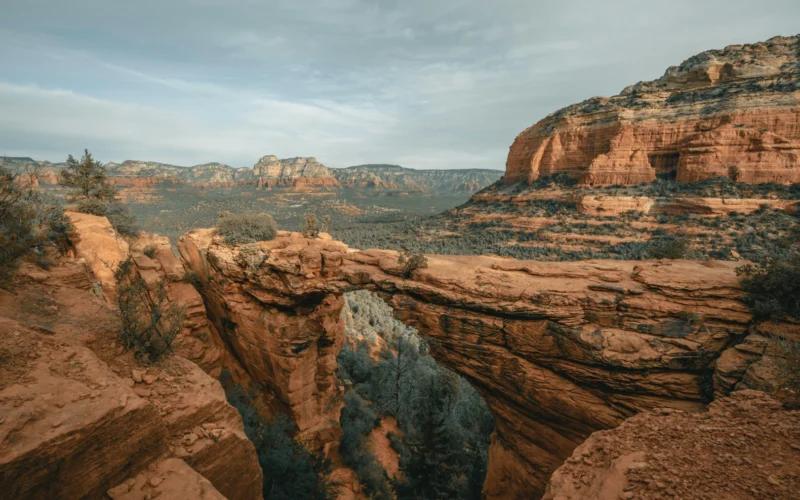
What’s left is a landscape that is essentially a cross-section. When you look at a Sedona cliff, you’re not looking at a rock formation so much as a stack of time, exposed edge-on.
Why the Sedona red rocks change color all day
Anyone who’s spent a full day here has noticed it: the rocks look different at 9am than at 6pm, and dramatically different in the twenty minutes before sunset.
That’s not the rock changing. It’s the light.
Sunlight at midday travels a shorter path through the atmosphere and arrives comparatively neutral, which flattens the red and washes out the contrast. Near sunrise and sunset, that light passes through much more atmosphere, scattering away shorter blue wavelengths and leaving warmer reds and oranges to reach the ground.
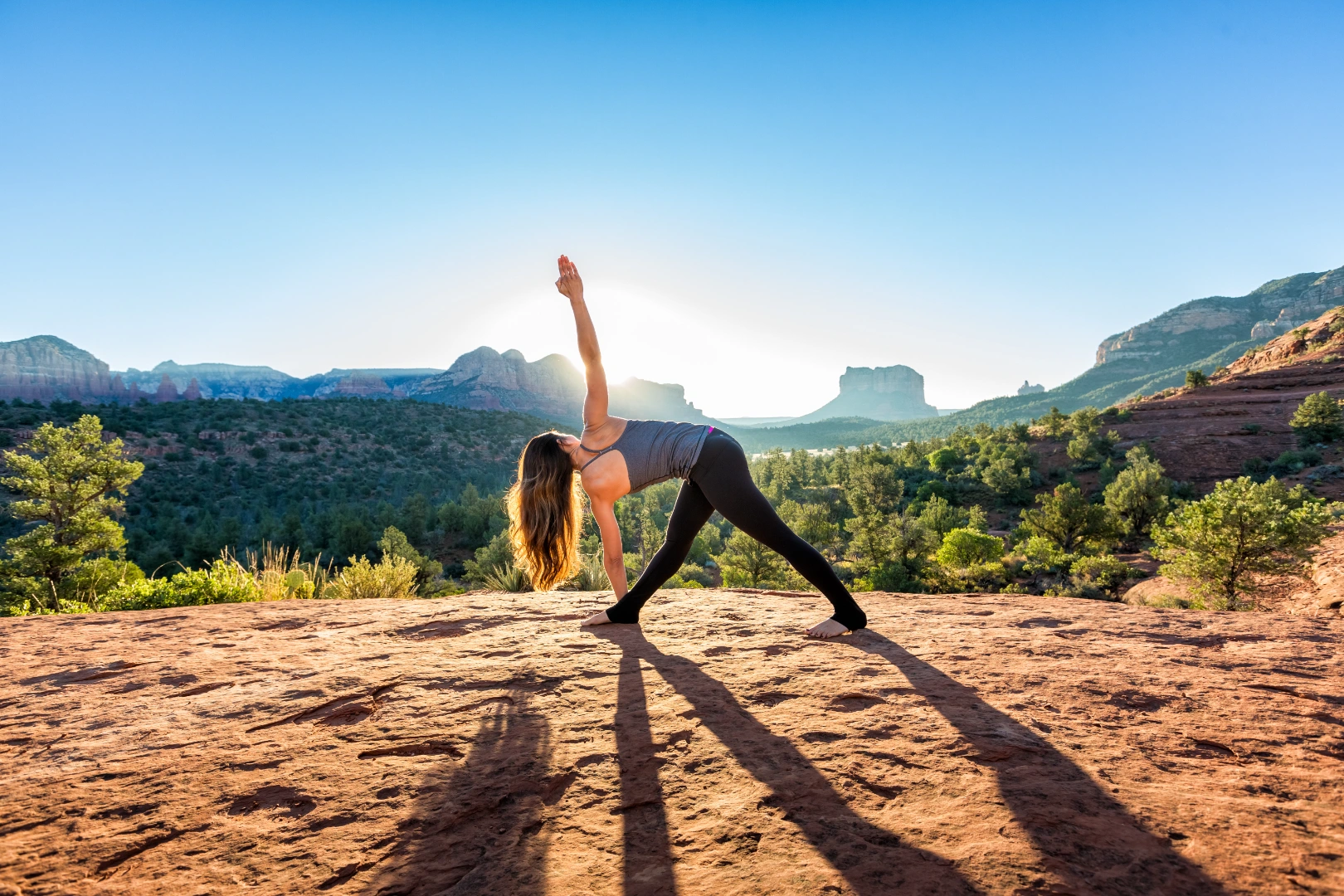
Warm light hitting rock that’s already red is why golden hour in Sedona looks the way it does, and why photographers plan entire trips around a forty-minute window.
Practical takeaway: if you have one morning and one evening in Sedona and you want the postcard version, go early and go late. The middle of the day is for hiking in shade and sitting somewhere cool.
Four things to look for once you know
Now that you know what you’re seeing:
- Cross-bedding, those sweeping diagonal lines. Ancient dunes.
- The color break, where deep red gives way to pale cap rock. That’s a change in both iron content and hardness.
- Ledges and slopes, harder layers form vertical cliffs; softer layers form the sloping shoulders between them. The stair-step profile of a Sedona butte is a hardness map.
- Desert varnish, dark, almost blue-black streaks running down cliff faces. A thin surface coating that builds up over very long periods, and often what ancient rock art was carved through.
And the honest disclaimer
Geologists have spent well over a century working out this sequence, and the details are more nuanced than any single article can carry, layer names, dates, and depositional environments all come with active scholarly discussion behind them. If this hooked you, the Sedona Heritage Museum and the local ranger stations both point toward good deeper reading, and a guided geology-focused jeep tour is genuinely worth the money.
See it from the ground up
The best way to appreciate 280 million years of rock is unhurried: an early hike while the light is still low, a long afternoon of doing nothing much, and a patio at sunset when the color comes back.
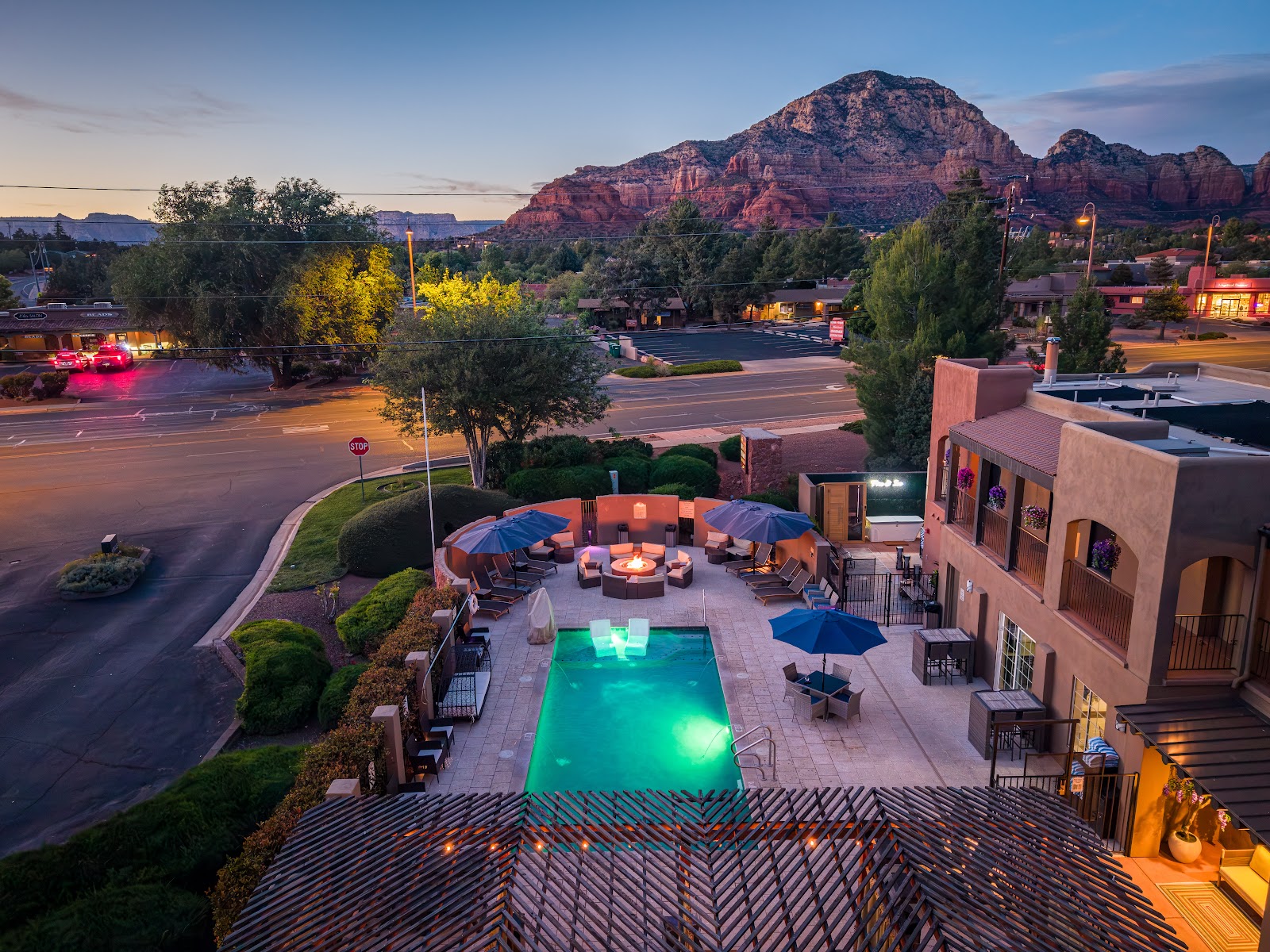
Arroyo Pinion is set up for exactly that rhythm, a boutique wellness hotel in West Sedona, close to trailheads, with a salt room, red light therapy, a relaxation room, and a pool and cabana area for the middle of the day. Rooms with patios and fireplaces for the cool evenings, when the rocks put on their best show.
The geology’s been waiting 280 million years. Give it a weekend.